Rubeus Hagrid
Rubeus Hagrid, the half-giant gamekeeper and Keeper of Keys and Grounds at Hogwarts, is a figure of immense physical strength and even greater emotional vulnerability, whose deep attachments to magical creatures and to his students define his role in the story. In Harry Potter and the Half-Blood Prince, Hagrid's grief over the impending death of his beloved pet acromantula, Aragog, and his subsequent mourning for the murdered headmaster, Albus Dumbledore, reveal the profound personal cost of the war and underscore his unwavering loyalty to those he loves.
Identity and Role
Hagrid is the Hogwarts gamekeeper, a half-giant with a shaggy beard and a heart as large as his frame. He is a loyal friend to Harry Potter, Ron Weasley, and Hermione Granger, and a devoted servant of Albus Dumbledore. His role extends beyond groundskeeping; he is a teacher of Care of Magical Creatures, though his lessons often reflect his own eccentric and dangerous passions. He lives in a small cabin on the edge of the Forbidden Forest, surrounded by the creatures he cherishes, including his enormous boarhound, Fang, and the hippogriff Buckbeak, whom he rechristened "Witherwings" for safety. Hagrid's deep emotional investment in his monstrous friends is a defining trait, as seen when he bursts into tears over the dying Aragog, a giant talking spider he raised from an egg. He is also the half-brother of Grawp, a giant whom Dumbledore helped relocate to a cave in the mountains, and with whom Hagrid maintains a hopeful, if one-sided, relationship.
Arc Through the Plot
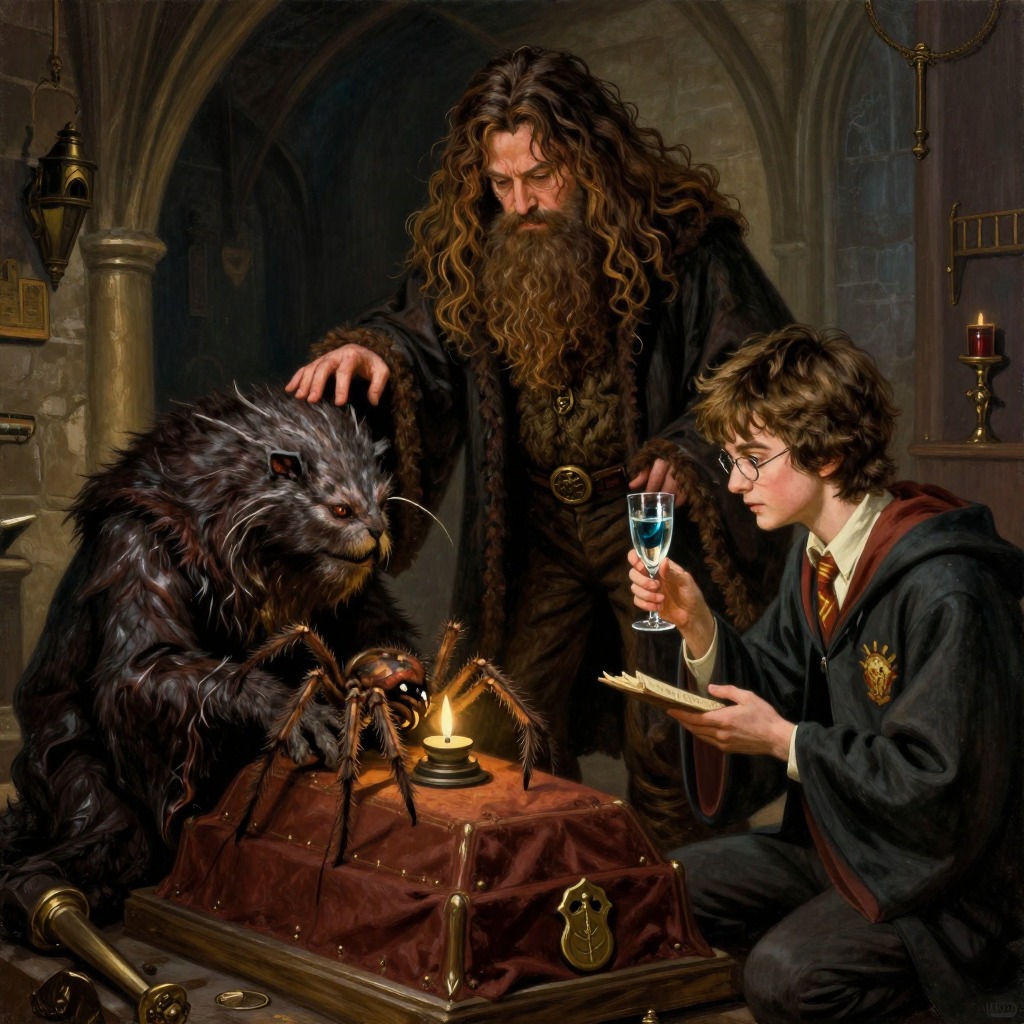
Throughout the year, Hagrid is a constant, if often absent, presence. He is late for the start-of-term feast because he lost track of time visiting Grawp. He becomes increasingly withdrawn after Harry, Ron, and Hermione drop Care of Magical Creatures, feeling personally rejected. His emotional crisis peaks with Aragog's illness and death. Hagrid's grief is so consuming that he buries the giant spider in his pumpkin patch, a task he cannot face alone. He invites Harry to the burial, and through a stroke of luck involving Felix Felicis, Harry brings Professor Horace Slughorn along. Slughorn, hoping to harvest valuable acromantula venom, helps Hagrid through the ceremony, getting him drunk on wine. This event inadvertently allows Harry to finally secure the crucial memory from Slughorn. Hagrid's personal tragedy is thus woven into the larger plot against Lord Voldemort.
Relationships and Conflict
Hagrid's relationships are marked by fierce loyalty and frequent misunderstanding. He feels hurt when his three favorite students do not continue with his subject, Care of Magical Creatures, and initially refuses to speak to them. They must force their way into his cabin to reconcile, explaining that they could not fit the class into their schedules. His bond with Harry is particularly strong; Harry is the one he turns to for comfort during Aragog's decline. Hagrid also has a fraught relationship with Argus Filch, the caretaker, whom he openly derides as a "sneakin' Squib." His loyalty to Dumbledore is absolute, and he is devastated by the headmaster's death. During the Battle of the Astronomy Tower, Hagrid attempts to stop the fleeing Death Eaters, setting his own cabin on fire in the process. He is wounded in the fight, but survives.
Change and Ending
Hagrid's arc in this book is one of loss and endurance. He loses Aragog, his oldest companion, and then Dumbledore, his greatest protector and friend. At Dumbledore's funeral, Hagrid is the one who carries the headmaster's body, wrapped in purple velvet spangled with golden stars, to its final resting place by the lake. He is so overcome with grief that he can barely see, and he is comforted by his half-brother Grawp, who pats him on the head. Despite his sorrow, Hagrid remains at Hogwarts, stating it is his home. When the staff debate whether the school should close, Hagrid insists he will stay and teach any students who want to learn, embodying the resilience and loyalty that define him.
Thematic Significance
Hagrid represents the theme of unconditional love and the value of all life, no matter how monstrous. His grief for Aragog, a creature most would find terrifying, highlights his capacity for compassion. His unwavering faith in Dumbledore, even in the face of Snape's betrayal, underscores the novel's exploration of trust and loyalty. Hagrid's simple, emotional nature contrasts with the complex political machinations of the Ministry and the cold cruelty of the Death Eaters. His presence serves as a moral anchor, reminding the reader of the personal, human (and half-giant) costs of the war against Voldemort.